
Think You’re Crushing It? Your Brain’s Lying — Save Every Bet and See the Truth
Football bet tracking screenshots: summary KPIs, market and outcome tables, ROI by league and team — why a complete bet log powers real sports betting analytics.
If you only remember your big wins, you will almost always feel smart — until you stack every stake in one place. A proper football bet tracker turns vague confidence into a dated record: stakes, odds, results, and competition — the raw material for betting statistics you cannot gaslight yourself about later. Here is a real example: 69 logged singles, 60% win rate, about +€84 profit and +12% ROI — but the headline is not the whole story. The screenshots below show where that money really came from… and where it leaked.
Market type, outcome, league, and team breakdowns only work when the underlying data is complete — they ignore the story you tell yourself and reflect what actually hit your betting bankroll. The sections below mirror real Beathem Analytics screens so you can see how a single habit — log every stake — unlocks layered betting performance views.

Those four numbers — volume, hit rate, profit and loss, and return on investment — are what most people think they know from gut feel. In practice, without a betting journal, the brain smooths out bad runs and magnifies lucky streaks. When every settled ticket lives in one system, you can finally answer boring but profitable questions: are you actually positive after fees and voids, and is your edge repeatable across weeks, not just weekends you remember?
Why “I’m pretty sure I’m up” is not an insight
Memory loves shortcuts. A full log forces you to look at structure: which markets you play most, which outcomes you actually hit, and whether “I’m good at overs” is true in the data. The fix is a complete record tied to real fixtures and stakes — then the breakdown tables do the talking.
That is the difference between betting tips you half-remember and documented performance: one flatters you, the other shows which ideas paid rent. Beathem is built for the second — track first, interpret second — so your historical ROI is not a story you tell mates, but a number on the screen.
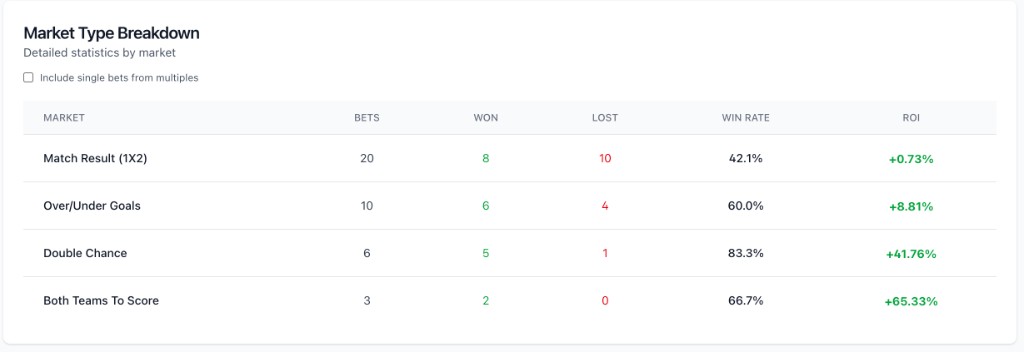
Market type: volume is not the same as edge
In this sample, Match Result (1X2) carries the most tickets — but look at ROI next to Double Chance or Both Teams To Score: the markets with fewer bets can still be where the account is healthiest. Without saving every bet, you would never line up “bets placed” vs “ROI” side by side.
Serious football betting research often starts with “what do I play?” — not just which league, but which bet types (match odds, totals, both teams to score). A market-type table answers that in plain language: it ranks what you actually stake on, then shows whether each bucket wins often enough to justify the volume. Volume without edge is expensive entertainment; this view makes that trade-off visible.
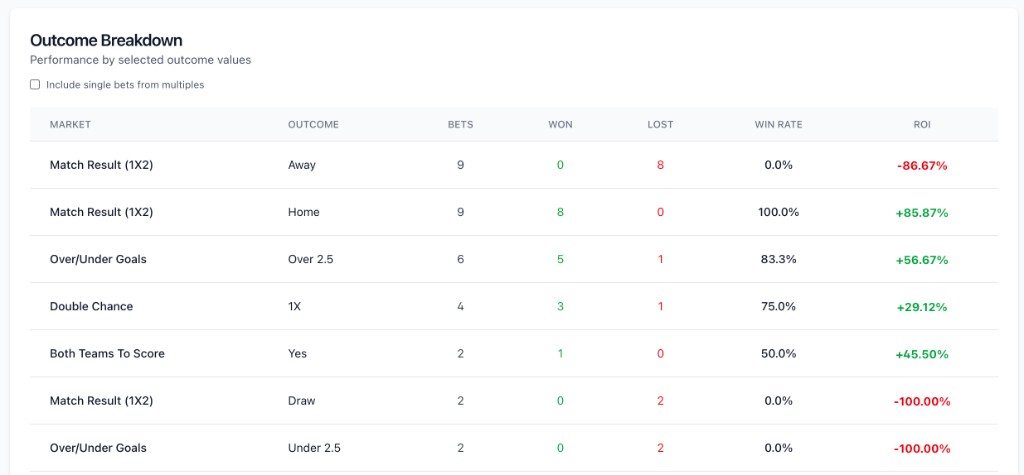
Outcome breakdown: the same market, opposite stories
Splitting by outcome is where it gets uncomfortable. Same market (e.g. 1X2): Home can look brilliant while Away or Draw drags the average. Over/Under rows tell you if “Over 2.5” is your friend and “Under 2.5” is a leak — not because of luck, but because the counts are there.
This is selection-level betting analysis: not “how is 1X2 doing?” in one lump, but which side of the coupon you keep funding. If you only ever talk about “my 1X2 game” without splitting Home, Draw, and Away, you can easily miss a pattern — for example chasing away dogs that never land — that a simple outcome table exposes in a few rows.
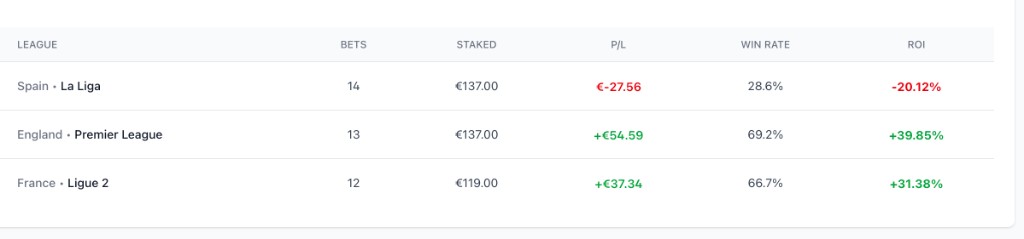
Leagues: same stake, different reality
One table can end the debate about “I’m good in Spain.” In this example, La Liga shows a deep red ROI while Premier League and Ligue 2 are green — same app, same rules, only the competition changes. That is not a vibe; it is what happens when you tag every bet to a league.
Filtering profit and loss by league matters because football rhythms differ: squad depth, scheduling congestion, and variance in scoring all shift by country. You might crush Premier League betting reads and still donate in another division — not because “Spain is rigged,” but because your process there was never audited. League ROI turns that hunch into rows you can act on (study more, stake less, or pause).
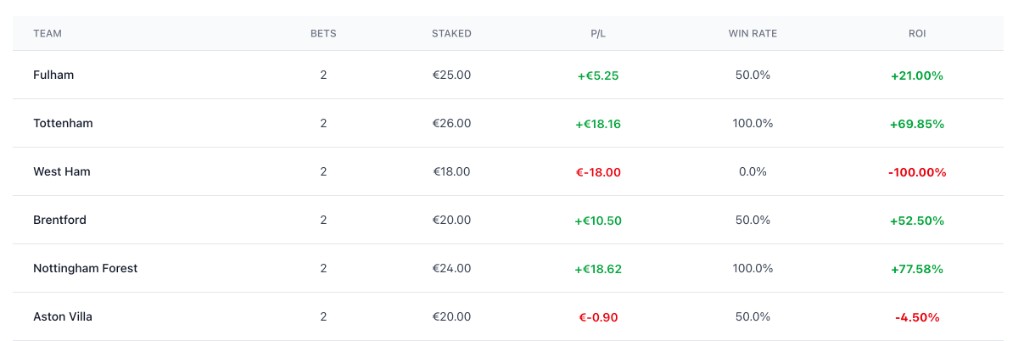
Teams: the last mile of honesty
Drill into teams and you see which shirts you keep backing — and whether they repay you. Some names run hot; others burn the stake. That granularity only exists if you log bets against real fixtures (not a note in your phone that says “Prem team”).
Team-level ROI is where narrative bias shows up fastest: fans over-weight “their” club; contrarians over-weight fading big names. The table does neither — it lists staked amount, P/L, win rate, and ROI per side so you can see whether your football betting strategy survives contact with real tickets. If one club keeps appearing in red while others fund the green, that is a prompt to tighten your rules for that team, not to argue with the spreadsheet.
The uncomfortable truth is the point
Sometimes the data says you are subsidising bad markets with good ones. Sometimes it says one country should go on pause. That sting is the product doing its job — so you can adjust with evidence, not stories.
What to log so these charts stay trustworthy
Insights are only as good as the underlying betting record. Save singles and multiples, use real fixtures where possible, and settle results when matches finish so win rate and ROI reflect reality. The more complete the log, the less you are optimising around gaps — and the more useful Beathem analytics becomes as a mirror, not a mood board.
Start ugly, finish honest
You do not need a perfect month to start. You need one saved bet, then another. Open My Bets and Analytics after a few weeks — the picture will already diverge from what you would have told yourself from memory alone.
Figures above are from an example account for illustration. Beathem is a tracking tool only — we do not take stakes or pay winnings. Bet responsibly; seek local support if gambling is harming you.